
In this story
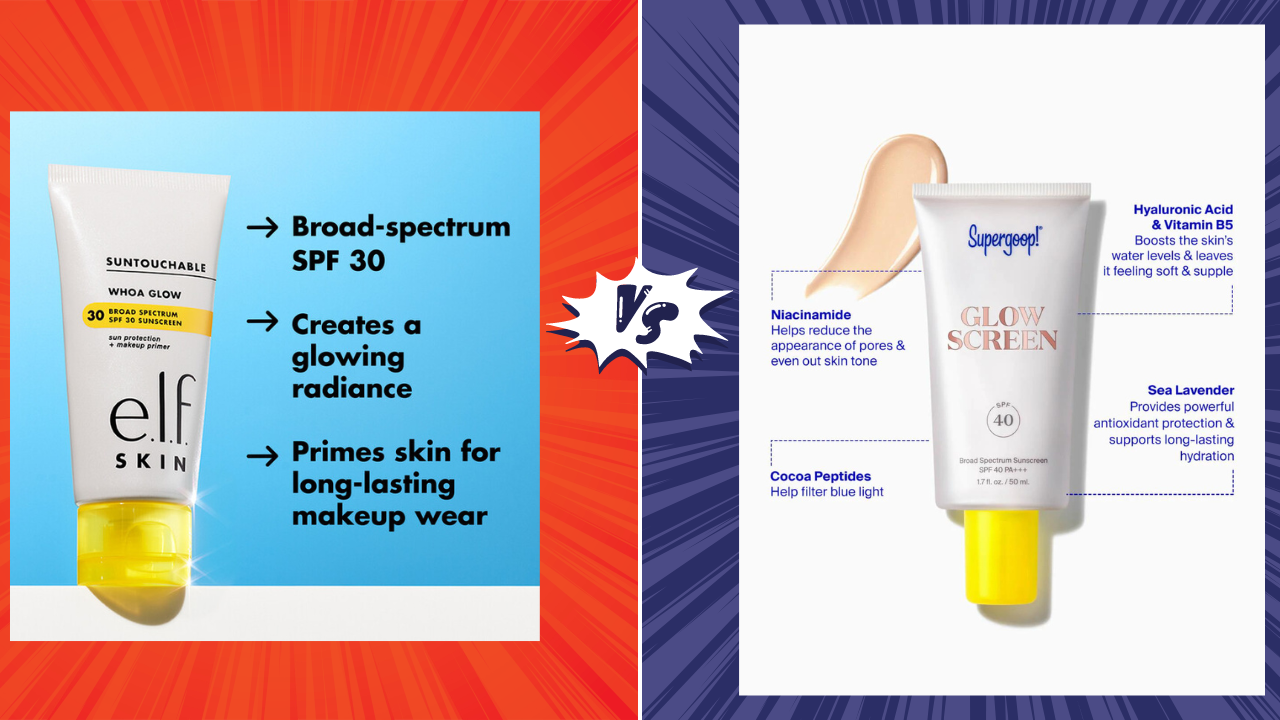
Sunscreen comparisons often begin with glow, white cast, or how a formula sits under makeup. Those details matter because a sunscreen you dislike may be hard to use consistently. But finish belongs after the basic protection criteria, not before them.
The most useful “dupe” is not simply a cheaper product with similar luminosity. It is a sunscreen labeled for the protection you need, in a format you can apply and reapply as directed.
Start with the protection label
The American Academy of Dermatology recommends choosing sunscreen that is broad spectrum, SPF 30 or higher, and water resistant. Broad spectrum refers to protection across UVA and UVB. Water-resistance labeling specifies a tested duration—commonly 40 or 80 minutes in the United States—not permanent or “waterproof” protection.
Read the current package in your market, because sunscreen rules and approved filters differ by country. Follow its directions and warnings rather than transferring instructions from another product.
SPF is not a countdown clock or a percentage you can scale casually. It is determined under standardized test conditions, including a defined application amount. Applying a very thin cosmetic layer is not equivalent to the labeled test.
Match the format to the day
Define the setting before comparing texture:
- Daily commute or mostly indoor day: comfort under usual makeup and willingness to reapply may be central.
- Outdoor exercise: sweat, water resistance, eye comfort, and portable reapplication matter more.
- Beach or pool: water-resistance duration, generous body application, shade, clothing, and reapplication become essential.
- Sensitive or reactive skin: a simple shortlist and careful testing may be more useful than chasing a particular finish.
One sunscreen does not have to win every setting. A fluid that feels elegant for daily wear may be inconvenient for covering the body; a durable outdoor lotion may not be your preferred makeup base.
The best comparison therefore names the job: “daily facial sunscreen under makeup” is more useful than “best SPF.”
Test appearance at a realistic amount
Apply each product according to its label, not as a tiny foundation swatch. Note spread time, areas that are easy to miss, residue around the hairline, eye comfort, pilling, and how long the film takes to settle.
If you compare two products on opposite sides of the face, keep the preparation and amount as consistent as practical. Test them without makeup first, then repeat with the same makeup on both sides. A sunscreen may pill because of the product beneath it, the amount of rubbing, or insufficient setting time—not only because of one ingredient.
White cast can change as a formula dries, and tinted sunscreens can add visible color. Evaluate in indirect daylight and on photographs with filters disabled. A tint that works for one depth or undertone is not universally transparent.
Do not reduce the amount simply to make a difficult formula look better in a review. That tests cosmetic elegance at under-application, not the labeled use.
Treat reapplication as part of the product
The FDA advises reading the label carefully and notes that no sunscreen completely blocks ultraviolet radiation. Reapplication directions depend on the product and activity, including swimming or sweating.
For a real-life comparison, ask whether you can carry, handle, and evenly reapply the format. Sprays, sticks, powders, cushions, and lotions can feel very different in use, and convenience does not guarantee adequate or even coverage. Follow the specific directions; do not assume a few casual passes of a touch-up format replace a complete application.
Makeup complicates reapplication, but it does not make the label optional. Plan a method you can execute for the exposure you expect, and use shade, hats, sunglasses, and protective clothing as part of the system.
Do not rank filters by fear
Terms such as “mineral,” “chemical,” “physical,” and “hybrid” are often used as safety rankings. They describe product categories imperfectly and do not tell you whether a finished sunscreen will suit your skin or meet its labeled performance.
Choose among legally marketed products that meet your label criteria and personal needs. If a clinician has told you to avoid a specific ingredient, follow that individualized advice. If a sunscreen causes a concerning reaction, stop using it and seek professional guidance when symptoms are significant or persistent.
For children, pregnancy, a history of skin cancer, photosensitizing medications, or a skin condition, general editorial guidance may not answer every question. Ask an appropriate health professional for advice tailored to the situation.
Compare cost only after usability
Normalize the package price by amount, then estimate how quickly you will use it at a proper application. A tiny facial bottle can have a low checkout price and a high cost per milliliter. Shipping and reliable local availability matter because sunscreen is a repeat purchase.
A lower-priced formula creates value when it clears the protection criteria and is usable enough to apply as directed. A cosmetically beautiful product that you ration can be a poor match for the role.
Write a bounded sunscreen verdict
A responsible verdict might read: “Both are broad-spectrum SPF 30+ and water resistant according to their U.S. labels; product A sets more quickly under our test makeup, while product B is less expensive per milliliter. Follow each label for application and reapplication.”
That language separates verified package information from one tester’s sensory experience. It also avoids implying that similar glow means interchangeable protection.
Sunscreen is only one part of sun protection. Pair it with shade, clothing, hats, sunglasses, and exposure-aware planning. Then let finish, price, and packaging decide which eligible formula is easiest to live with.
Turn the framework into a smarter product shortlist.
Use Dupes to compare products, inspect possible matches, and save the options worth revisiting.
Download on the App Store